Most of my teen years were spent on Amigas. I started with a 500, went through a 2000 and a 1200, and ended with a 3000T. At fifteen I was maintaining an Amiga-based information display system at Odessa College, riding my bike there to update the slides that played on televisions around campus. The Amiga was also where I started Virtual Reality, my BBS in Odessa, in 1989. When I moved to North Carolina for the Marines, I renamed it Autumn’s Harvest Inn, which took its first call in January 1993, and ran it through 1996. I also wrote the Spectral Neurologix tools that went with it.
The board still describes the machine it ran on in 1996, and it was an A1200 too:
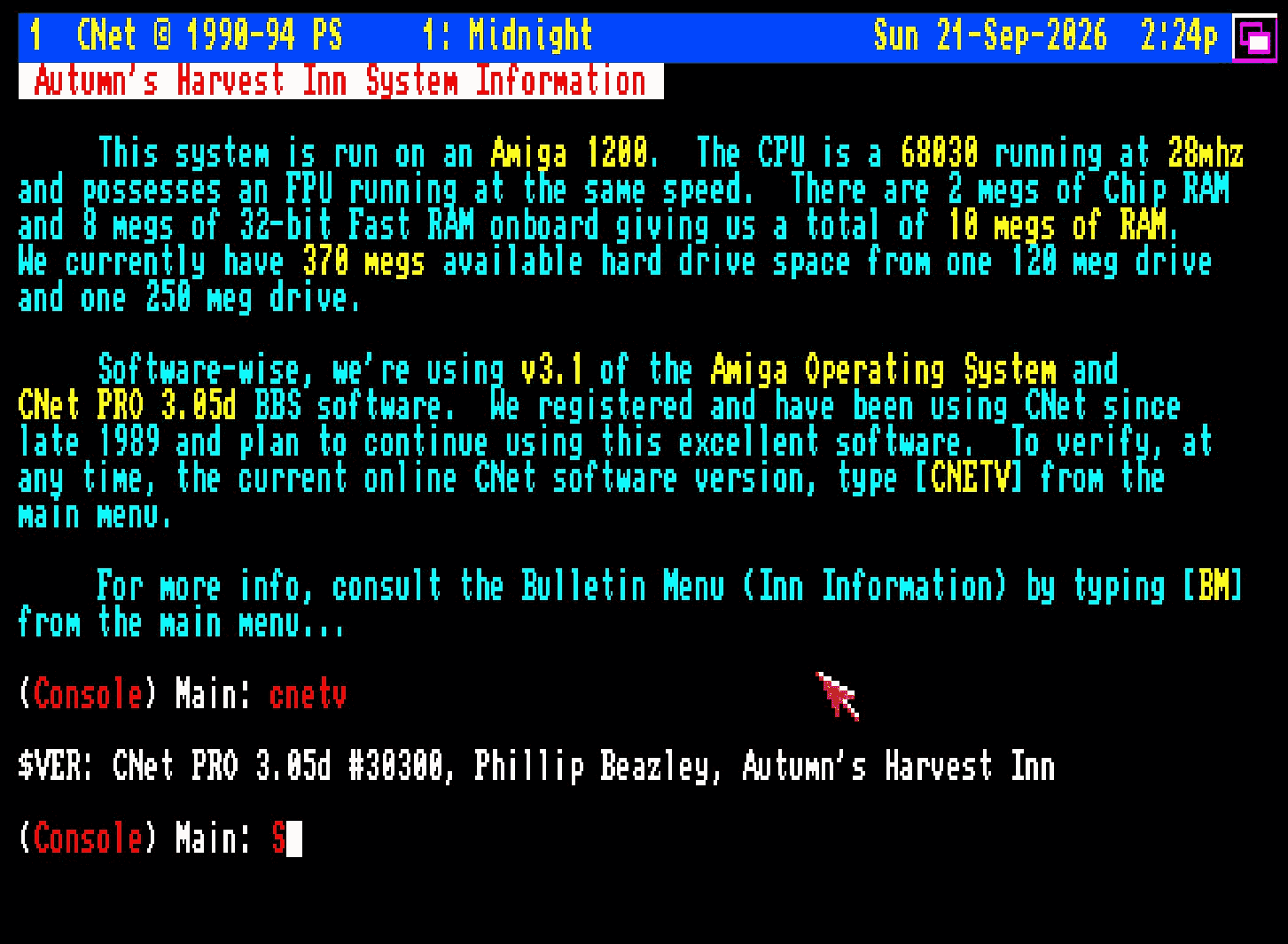
The machine in the current plan is an A1200 with a TF1260 accelerator, a 68060 at 50 MHz, and 128 MB of Fast RAM. The hardware notes describe an AmigaOS 3.2.2 installation. Getting the old board running on that machine is still ahead; the successful restoration so far is inside WinUAE on the PC.
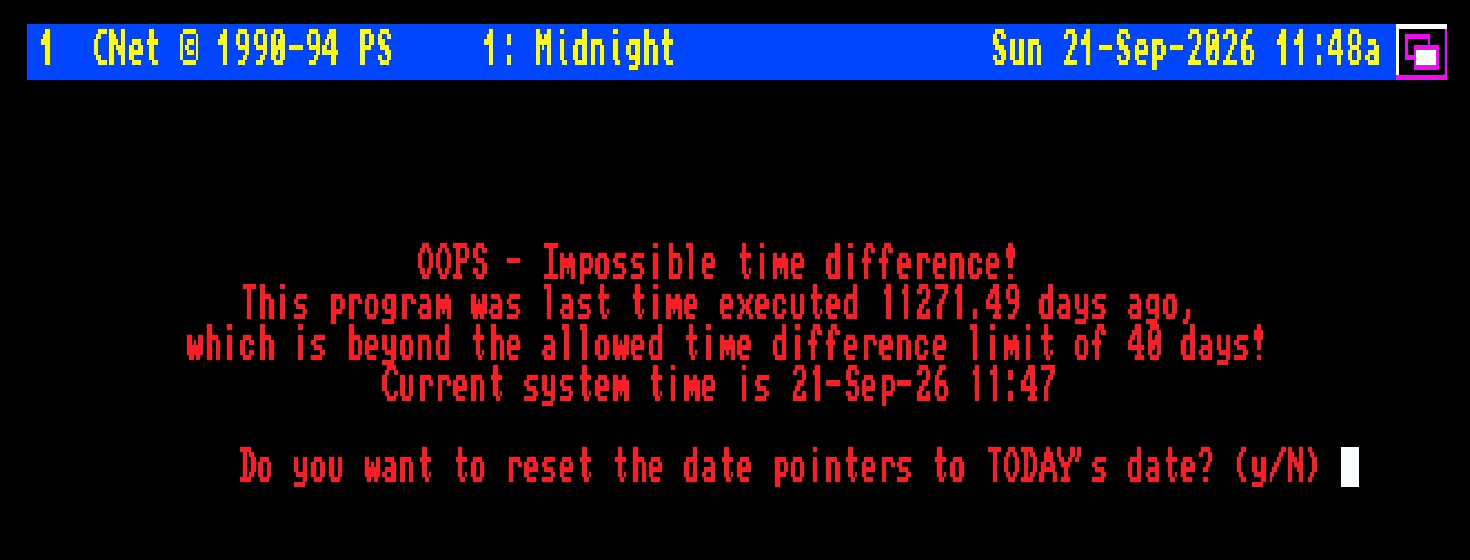
Some of the board’s own software noticed the gap before I did. One of its tools keeps a limit on how stale its date pointers can be, and thirty years is well outside it:
Having a specific job for it gives me somewhere to start. The BBS has files to recover, scripts to run, and callers to connect. Its startup also gives me a fairly direct test of how much of the old environment I have actually put back.
That environment has taken some reconstruction. The backup preserved the C-Net directory, but
the board referred to things through Amiga assigns such as Mail:, PFiles:, and SN:. Those
names let software refer to a location without baking in the physical drive layout. Restoring
the files meant restoring the names they expected too. Mail: was the exception: its volume was
never in the backup, so it came back as an empty folder I rebuilt by hand.
A fresh C-Net installation in a second emulated machine helped sort out what belonged where.
Comparing its startup with the restoration exposed a wrong FIFO setup that was freezing the
door programs. It also gave the restored board a simpler layout, with its files beneath one
Work:CNet directory and the original assigns pointing into it.
The board now starts from the Amiga’s own S:User-Startup. It doesn’t need to read a setup
script from the Windows repository at boot. That matters for the move to hardware: the Amiga
already carries the startup it needs, and the repository records how it was assembled.
The emulator is useful preparation, but there are differences to work through. It currently supplies the TCP stack. Since September 22, the WinUAE setup has used stock OS 3.1 and native AGA graphics, with no virtual graphics card. That matches the real A1200’s lack of a graphics card. A separate OS 3.2 rehearsal has also been running in WinUAE since September 25. For telnet on the physical machine, the plan is PCMCIA Ethernet and Roadshow beneath SerialTCP. That combination still needs to be tested here.
Meanwhile, the Inn is running again, including software I wrote for it in the 1990s. My SN DoorMenu package is dated October 3, 1995. It now launches Ants from the restored menus. There is a fair amount of new setup around it, but that part of the return is already working.